
Gynecomastia
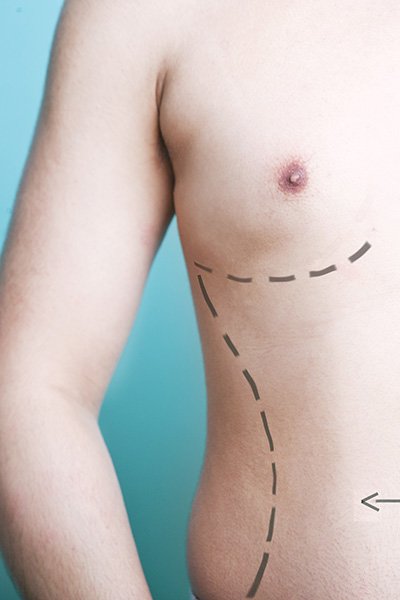
Gynecomastia – Aesthetic surgery of the male breast
The excessive growth (called feminization) of the male breast is called gynecomastia. During puberty, for hormonal or genetic reasons or in adulthood, for pharmacological reasons or overweight, an enlarged pectoral region in its glandular and adipose part is determined. The excessive development of the glandular part such as Gynecomastia should not be confused with swelling caused by the prevailing fat component. In this case, it consists of false Gynecomastia or, so called, Pseudogynecomastia.
Symptoms of Gynecomastia
Initially, it is revealed by the appearance of painful prominences in the area below the nipple and later with increased fat and glandular tissue associated with swelling.
Causes of Gynecomastia
The development of the mammary gland is determined by the dominance of female hormones (estrogens such as estradiol and progestin such as prolactin) as compared to the male.
In all these cases, female hormonal excess or male testosterone reduction creates an imbalance that may lead to breast gland enlargement. In fact, the estradiol is responsible for the epithelial proliferation of the gland tissue (parenchyma) and lactiferous ducts, whereas prolactin determines the development of glands and stimulates the production of milk proteins.
The testosterone cause an inhibitory function on breast development with an anti-estrogenic action. The same testosterone effect is blocked by cortisol and prolactin which facilitate breast feminization.
In addition to these hormones, there are non-specific hypertrophic hormones like the thyroid hormones that increase plasma estrogen, instead cortisol, insulin and GH growth hormone can help direct overall breast development.
The same fat tissue is rich in aromatase, an enzyme that converts androgen to free estrogen. That’s why the obese women during post-menopausal suffer less from the decrease of estrogen whilst overweight men produce reactive gynaecomastia due to increase of estrogen produced by adipose tissue.
The causes that contribute to pathological development are:
-Hormonal dysfunctions and metabolic dysfunctions, diseases that determine a hormonal imbalance such as diabetes (for excess insulin), Cushing’s syndrome (excess cortisol), pituitary prolactinoma, hyperthyroidism.
-Chromosomal disorders, Klinefelter syndrome that as a result of hypogonadism is characterized by a reduction of male hormones while prevails estrogens that cause gynecomastia.
– overweight, fat and obesity increase the transformation of cholesterol into female hormones in peripheral adipose tissue.
– pharmacological therapies (taking anti H2 gastroprotectective as cimetidine, medications for prostate hypertrophy like finasteride), medicines for hypertension such as spironolactone or other calcium antagonistic medicines for hypertension, antiretroviral medicines saquinavir or lopinavir, antipsychotics such as haloperidol or Olanzapin, cytostatic chemotherapy such as cyclophosphamid or methotrexate, phytoestrogens.
– using anabolic agents: the body transforms excessive anabolic male steroids into estrogens to protect itself and causes a dominant imbalance on feminization.
– cannabis abuse
Whatever the cause, the increase in the size of the gland on the pectoralis muscles results in sexual and social discomfort in those affected by it.
How to diagnose the Gynecomastia
The evaluation of the problem is done by at first with observation to establish any asymmetries of the position of the nipple, asymmetries of the chest, defects of the nipple like hypertrophic or inverted, and lastly doctor will proceed with breast palpation.
The surgeon establishes the nature of the Gynecomastia (if the condition of glandular or adipose origin persists) and requires a mammary ultrasound scan and possibly a mammography.
It will also require an endocrinological review with pituitary hormone tests (prolactin, male hormones and female hormones) if he suspects that the cause may be caused by disorders related to hypothalamus-pituitary gland relations, thyroid or adrenal glands.
Once a metabolic originated disease has been excluded( in this case surgery would be useless and an overtreatment), the surgeon decides on the correct kind of procedure for that patient related to the defect to be cured.
The patient should have an adequate state of health compatible with the surgery and the epidermis of the chest area must be sufficiently elastic. The patient will also explain the reasons and expectations of the choice to undergo the surgical procedure.
Preparing to surgery
In preparation for surgery, the doctor prescribes a series of routine clinical test such as an ECG, blood test with leucocytes formula, blood glucose, creatinine, azotemie, plasma electrolytes (chlorine, calcium, potassium, sodium) total protein, liver function (ast, alt), coagulation (pt, ptt), endocrine blood tests, breast ultrasound
It is essential to avoid taking aspirin and NSAID derivatives for at least 7 days before surgery (and even after): the acetylsalicylic acid contained in the medication may reduce the clotting ability of the blood.
Surgery
The operation is performed as day hospital or, at most, with a one night of hospitalization and it takes about 60-90 minutes under Local aneshtesia and mild intravenous sedation so to leave the patient on spontaneous breath.
The patient is able to go home after a few hours.
If the pathology is determined by the hypertrophy of the mammary gland the surgical technique consists of a half around areola incision (half-moon) in the lower quadrant, through which the excess glandular tissue will be removed: it is called subcutaneous mastectomy.
This surgical technique, in case of mammary ptosis (breast sagging) is associated with tissue lifting (Mastopexy according to Davidson’s technique) and removal of excess skin by means of a complete around areola scar.
At the end of the surgery the drains are placed and the patient wears a compressive garment.
If, on the contrary, the pseudogynecomastia occurs after a period of obesity followed by huge weight loss resulting in skin sagging and ptosis, it will be possible to correct it by liposuction
At the end of the procedure, the patient is treated with a compressed patch or with a special compressive garment.
Risks and complications
After surgery, there may be episodes of swelling in the chest area (which tend to disappear in a few days) and accumulation of blood in the area affected by the operation.
In some cases, hypertrophic scars may occur around areola. A relapse of Gynaecomastia can also occur after mastectomy, because a part of the gland is left, after hormonal stimulation or weight gain (fat actually releases endogenous estrogens – estriol).
In some cases, may appear seroma or hematoma. Infections are also rare thanks to antibiotic therapies. The loss of nipple sensation is usually temporary and almost completely recovers over time.
Post surgery
The wound heals after about 15 days however the final result will be appreciable only at the end of the convalescence, after a few weeks or months.
After the surgery, it will be necessary to follow some precautions indicated by the doctor, like:
make lymphatic drainage massages in the mammary region
limit work activities (especially if they require considerable physical effort)
do not drive the car in the days immediately following the intervention
do not use a shower and bath for at least two weeks
Do not return to sports activities for about a month and a half
Price
Indicatively the costs for a Gynaecomastia surgery can vary from 4500 to 6,500 euros.
USEFUL INFORMATION
Lasting
Complexity
Anesthesia
Dressings
healing time
B/A pictures


