After cancer breast recontruction
Breast reconstruction surgery is an integral part of the breast cancer treatment process. Plastic surgery, especially in recent years, has finally become part of the treatment programme. Through breast reconstruction, the patient undergoes a set of procedures that aim to restore volume and shape similar to those lost due to the disease. Challenging breast cancer is a twofold battle: on the one hand, the fight for life; on the other, the fear of being disfigured. And with this in mind, every woman facing such a problem must be supported and guided in weighing up the pros and cons of all possible surgical options, with information on costs and benefits, both in terms of aesthetics and health.
Specialist examination
Among the many options offered by surgery, the ideal one is discussed and established during the preliminary specialist visit with Dr Tommaso Savoia and with the referring breast specialist if reconstruction is done at the same time as demolition.
Basically, breast reconstruction depends on the patient’s general state of health and the type of problem to be addressed:
creation of breast relief
symmetry with the other breast
areola-nipple reconstruction
tissue restoration
Before undergoing the operation, the candidate must undergo a series of routine checks such as clinical and laboratory examinations, electrocardiogram and chest X-ray. In the preceding months, the patient must have had a mammogram and breast ultrasound to rule out residual gland disease.
The operation is performed under general anaesthesia, but in the moments before the operation, drawings are made on the skin as a rough indication for the incisions.
Surgery

Ricostruzione mammaria con protesi
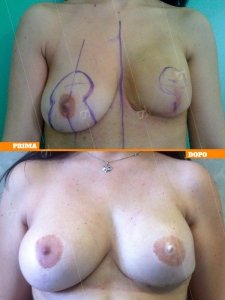
After a conservative operation such as quadrantectomy (selective removal of a malignant lump and breast quadrant as a corresponding functional aesthetic unit), the surgeon is responsible for restoring volumes by means of remodelling techniques with glandular flaps and reduction mammaplasty and mastopexy techniques that place scars in less visible areas and allow an overall aesthetic improvement (glandular flaps, glandular self-implantation techniques).
At least 6 months after this operation and after radiotherapy, lipofilling techniques (a minimally invasive technique involving the harvesting of adipose tissue by means of microcannulas and its reinsertion after centrifugation in the emptied areas) can be performed to obtain tissue restoration and the removal of any residual scar adhesions. This technique also known as Lipostructure involves procedures to release subcutaneous adhesions with dedicated needles (Nokor’s needle, dovetail, Rigottomie, subcision) contextual to the filling.

Ricostruzione con espansore cutaneo
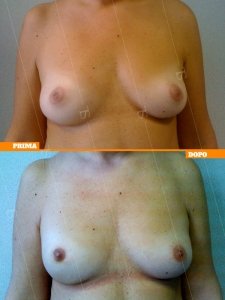
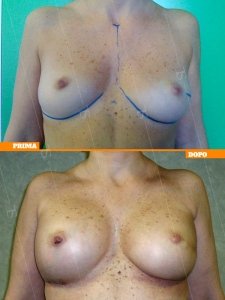
Nipple areola sparing mastectomy(NAC sparing), thanks to which the entire skin covering of the breast is maintained, reconstruction involves implanting a definitive prosthesis in a totally submuscular plane (subpectoral, subfascial and under the gran dentate) achieving a definitive reconstruction; if this procedure is not feasible, a skin expander (skine expander) can be implanted, i.e. a balloon housed in the same submuscular plane, which is then filled over the following 6 months in short outpatient visits to obtain an expansion of the skin and muscle sufficient to accommodate the prosthesis of the required size comfortably and without tension on the tissues.
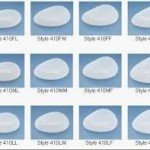

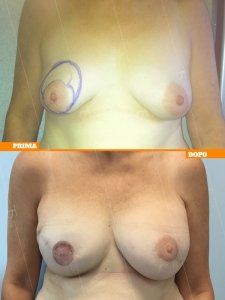
After Madden-type radical mastectomy (which involves the removal of the nipple-areola complex) it is often necessary to implant the breast expander with the same technique as before, while the nipple-areola complex will be reconstructed at a later time.
Reconstruction can take place by using autologous tissue, i.e. muscle flaps (Great Dorsal muscle or Rectus abdominis muscle) to restore the lost volume in a single time. Also in this case the nipple-areola complex will be reconstructed at a later date.
In conclusion, breast volume can be reconstructed through the grafting of
– autologous tissues (flaps and lipofilling)
– expanders or implants
– both

Latissimus dorsi Breast reconstruction
In the first case, a very natural result is ensured by using adipose tissue from the patient herself. The reconstructed breast will be very similar in shape and volume to its contralateral. The operation is also compatible with post-operative radiotherapy.
In the second case, which involves the use of prostheses, the advantage is that it reduces the physical stress of taking tissue from the patient to prepare it for grafting. The disadvantage is a result that is likely to be less natural and, above all, incompatible with radiotherapy.
The two types of operation can be combined in a single procedure, but the reconstruction also depends on the quality of the tissues being operated on, their thickness, elasticity, muscular structure and the layout of the (future) scars.
Post-operative
After the operation, the patient must follow antibiotic and anti-inflammatory therapy. Daily or work activities can be resumed very slowly after the operation, depending on the healing response of the drainage.
Those who do physical activity, as long as it is ‘soft’, can resume it gradually after the doctor has given her carte blanche.
Important: wear an elastic sports bra that supports and protects.
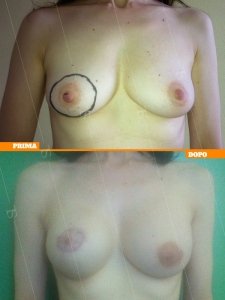
Before and after pictures breast reconstruction