Why a capsular contracture forms in breast augmentation surgery
When encountering a complication such as capsular contracture “NO panic!” is Dr Savoia’s answer.
During breast healing after breast augmentation surgery, a woman’s body physiologically activates a process of isolating the breast implants from the rest of the body.
This is a natural reaction of the body that tends to create a protective barrier, a real envelope (the so-called periprosthetic capsule) that covers the breast implant, stabilizing it and isolating it from the rest of the body. This film is made up, when normal, of connective cells called fibroblasts mixed with collagen fibres and has a shiny whitish appearance.
Inside the capsule is the prosthesis surrounded by a minimal amount of physiological fluid that acts as a lubricant to reduce friction with the prosthesis. What this film will look like depends partly on a genetic predisposition of the individual and partly on the characteristics of the surface of the implanted prosthesis that acts as a ‘footprint’ for its formation.
Symptoms of capsular contracture
In some patients, often only on one side, the body during healing overreacts with an inflammatory process that produces too much fibrous connective tissue to result in a hard, thick capsule responsible for pain and a breast that is hard to the touch.
After how long does capsular contracture form? It can occur initially as early as 1 month into the healing process and its formation or even several years later due to various causes such as silicone bleeding.
Biologically speaking, the hardened capsule is dominated by connective cells known as myofibroblasts, which have such a contractile capacity that they cause pain and deform to the point of displacing the prosthesis itself due to a centripetal and concentric effect.
This is a clinical complication called ‘capsular contracture’, classified by Baker according to a four degree scale:
Grade I: absence of contracture, the prosthesis is neither palpable nor visible. It is present in all normal cases.
Grade II: the breast is slightly less soft than a ‘normal’ one, but many women do not complain of the problem.
III and IV degree, the most severe ones, with palpable and visible prosthesis in its rim, hard breast, painful to the point of being deformed and absolutely unnatural due to the displacement (prosthetic dislocation) of the breast implant. This type of problem was much more frequent in the past due to the poor quality of the materials used and inaccurate sterilisation, but it is still possible in some cases.
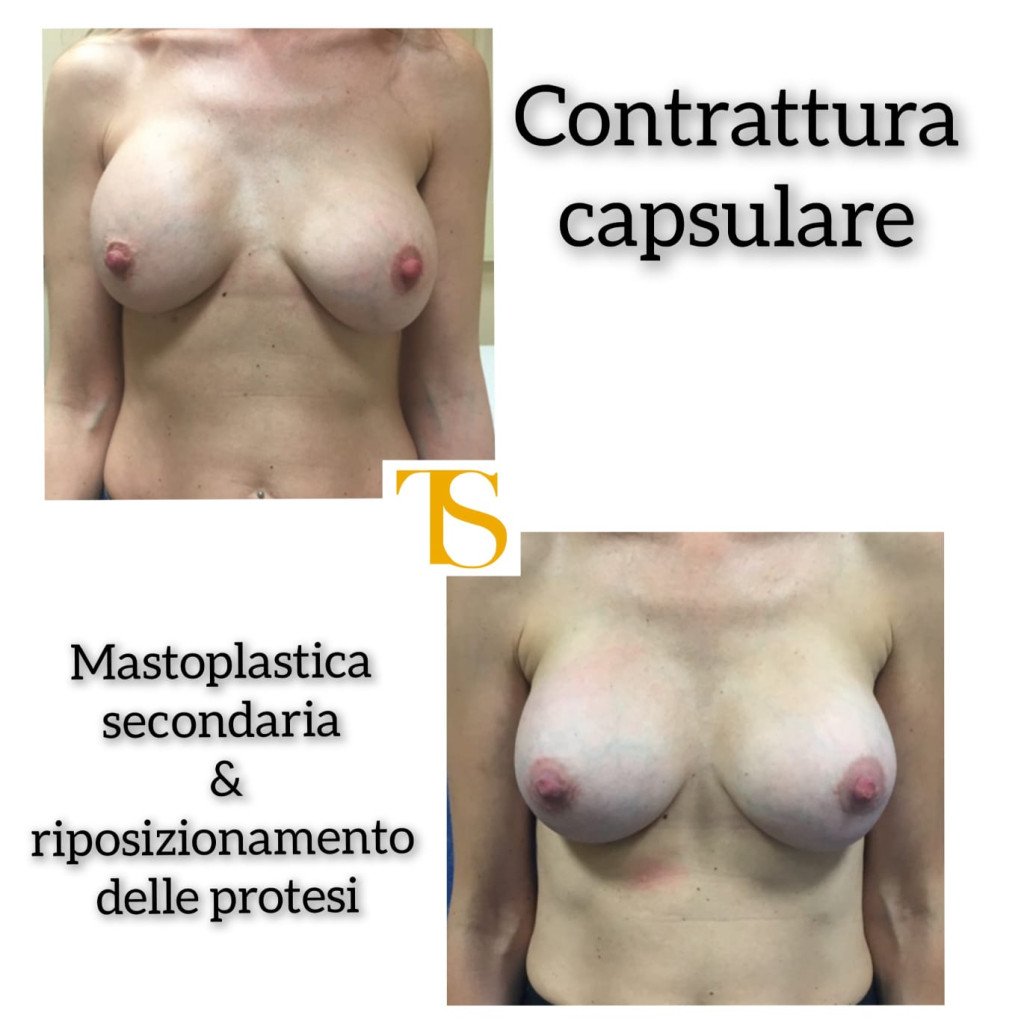
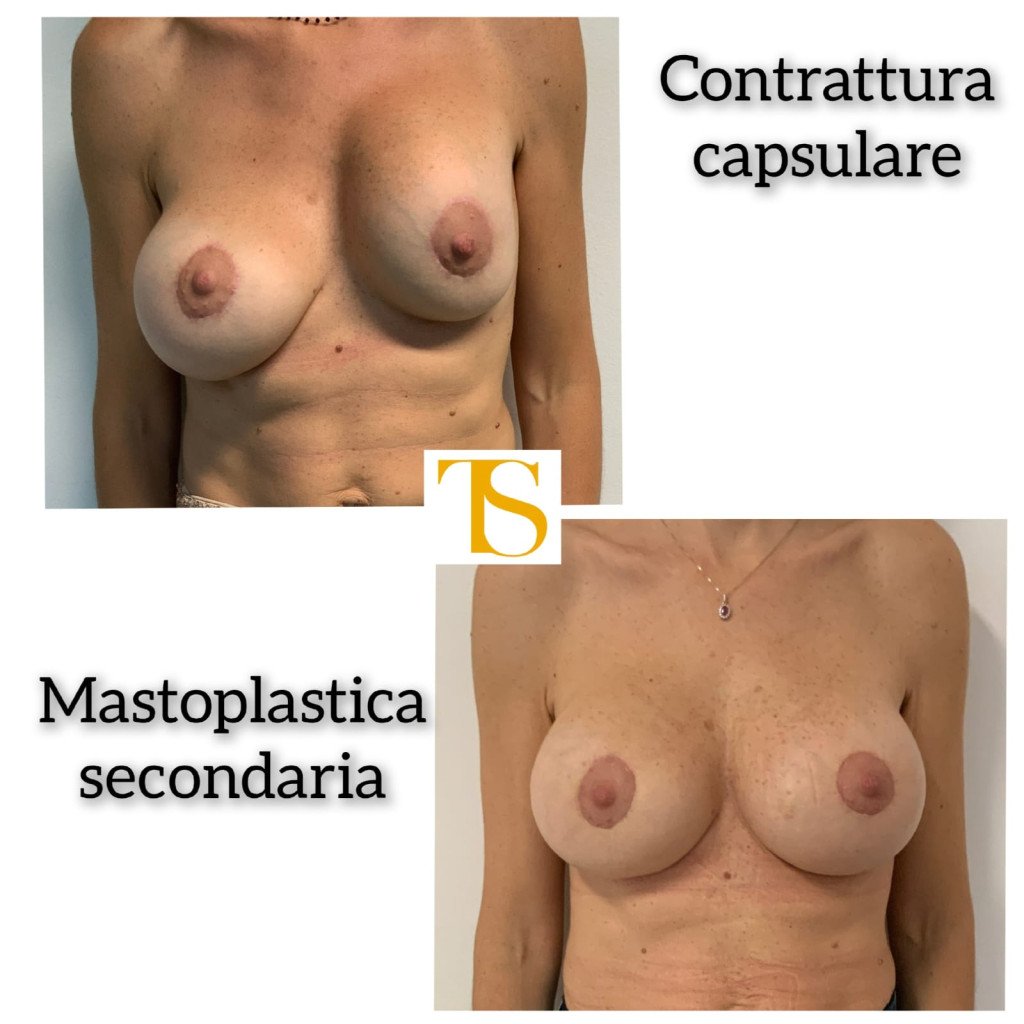
What a contracted breast looks like
In the case of contracture, the breast presents itself as
a breast that rises in position relative to the other side
breast that ovalises in shape and the base narrows (from round becomes oval in vertical)
the underside of the gland is emptier and laxer compared to the other breast
one breast compared to the other is more sensitive to the touch and is harder to palpation
Causes of capsular contracture
This phenomenon occurs more frequently in the case of breast reconstruction operations (30%) than in cosmetic mastoplasty operations (3%) due to the greater commitment to tissue repair that a breast operated for an oncological reason presents compared to the aesthetic case.
Radiotherapy following a quadrantectomy or mastectomy causes contracture due to damage to the vascular tissue that nourishes the gland (actinic angiopathy).
Some older or older implants (after about 10 years the implants should be given a serious check-up) may ooze silicone or release particulate matter from the surface due to the continuous friction of the macro-textured rough material with the body. These phenomena lead to chronic inflammation that hardens the fibrous tissue of the capsule, causing it to contract.
Sometimes a post-operative haematoma (collection of blood) around the prosthesis, if not reabsorbed by the tissues, can prevent a proper response to infection and cause a longer inflammatory healing process that increases the likelihood of contracture due to increased deposition of collagen tissue.
It is also a more frequent phenomenon when having a retro- or sub-glandular implant in thin patients with thin skin, while in contrast in the case of a submuscular or dual plane implant the pectoralis muscle has a massaging effect and reduces the likelihood of its occurrence.
It can be caused by an excessively large prosthesis that causes, due to normal daily movements, continuous traumatism to the prosthetic capsule, which then induces a new inflammatory repair process that makes the shell thicker and stiffer at the expense of its elasticity.
The presence of biofilm on the prosthesis, i.e. a subclinical microinfective state, may lead to a greater inflammatory response and thus to a greater release of fibroblasts until a thicker capsule is formed. Sterility in the surgical procedure of prosthesis insertion, reduced drainage time, and the use of antibiotics are surgical protocols that reduce risks. Recently, the insertion of prostheses using an instrument called the Keller Funnel, a kind of funnel shaped like a ‘pastry bag’ to minimise the contact of the prosthesis with the skin of the incision, has been included in the surgical practice of breast augmentation.
In recent years, some Allergan or Macghan macrotexturized prostheses, due to a certain type of macrotexturization, have led to a high frequency of complications such as the formation of a ‘double capsule’ and chronic seromas, and have therefore been withdrawn from the market.
Capsular contracture or Rippling ?
Rippling is the phenomenon characterized by the appearance of folds and undulations in the upper and inner part of the breast after breast augmentation surgery.
Unlike contracture it has a different cause but in some cases it can occur in the same patient who already has a contracture particularly in very thin patients and when bending forward or in the outer axillary margins of the prosthesis.
The causes of rippling are :
-too thin prosthesis coating as in cases of implants in thin patients with an almost non-existent breast and in position behind the gland
-excessive laxity of the capsule (i.e. the opposite of contracture) because the pocket is too wide in relation to the implant or if it is too loose in relation to the prosthesis (often smooth), resulting in an implant that is too mobile
-poorly filled implants or round implants with a poorly cohesive gel, these are the cases in which there is less adherence of the external skin to the glandular so these undulations are created.
How to diagnose capsular contracture
The diagnosis is almost always clinical with a visit to the surgeon who, through anamnesis and recognition of symptoms and palpation, will determine the level of severity of the contracture.
A breast ultrasound at a breast centre is also used to assess the state of the prosthesis, since a prosthetic capsule that is too rigid causes chronic inflammation and damages the prosthesis with an increased frequency of rupture. A further diagnostic investigation in suspected implant rupture requires a nuclear magnetic resonance of the breast.
How to prevent capsular contracture
Choose a submuscular implant is less likely to contract
Choosing a prosthesis that is not too large in relation to the tissue that can contain it reduces the risk of contracture.
The new nano-textured prostheses (Motiva ergonomix) produced by a printing process (no release of friction particles) induce a very thin prosthetic capsule in the body resulting in a very natural and soft effect in addition to the natural softness of their gel.
Polytech’s polyurethane-coated prostheses have demonstrated a reduction in the likelihood of contracture and are of choice in revisions after primary contracture. The prostheses are made of silicone and coated with a layer of polyurethane that is integrated and reabsorbed within 10 years. This film, having greater adhesion and integration with the tissue, has a more vascularised capsule that can prevent the formation of the contracture by means of an antibacterial and anti-inflammatory action.
Smoking in the two weeks following implantation of implants increases the risk of contracture by up to two times.
Massaging the implants, especially in the first month for 10 minutes twice a day, can prevent the complication but can also cure it in the early and less severe stages.
Taking Zafirlukast (Accolate) (an anti-inflammatory that acts on the leukotriene mechanism used in asthma therapy), although it has never had definitive scientific validation, is used off-label by some surgeons empirically to treat the contracture.
Solutions and remedies for capsular contracture
Post-operative but also remote massage performed by skilled hands or through the instructions of one’s surgeon can really solve capsular contracture up to grade III.
The use of a thoracic band to be put on in cases of dual plane or retropectoral mastoplasty can help to counteract the rising of the prosthesis from muscle contracture but also from the formation of a very hard capsule because it stabilises the prosthesis in place and has a stretching effect on the muscle fibres.
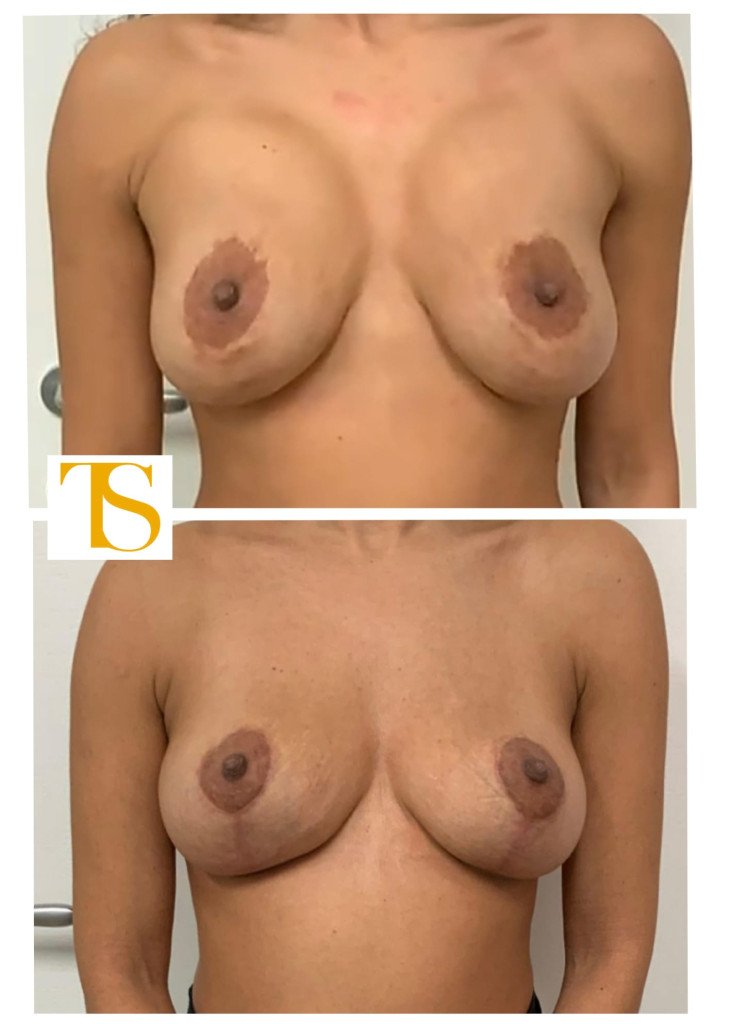
In serious cases, where pain or deformity is very significant, it will be necessary to replace the prosthesis, preferably with polyurethane ones, and at the same time to make an incision in the capsule (capsulotomy) to extend the surface or a complete removal of the capsule (capsulectomy) so that the new prosthesis forms a completely new one.
Warranty of breast implants
Breast implants are guaranteed for the eventuality of capsular rupture and contracture.
Most manufacturers return a single prosthesis or allow you to choose a pair as well to allow for a revision, however bilateral as you are undergoing a new operation.
Some implant manufacturers also guarantee financial reimbursement in addition to the implants for the out-of-pocket costs of the operating theatre and surgical team.
Conclusions
This phenomenon is sometimes not predictable, but Dr Savoia has selected materials of excellence and with an excellent level of tolerability for his patients, customising the procedure and following worldwide recognised standards to try to reduce this risk to a minimum.
Related pages: Secondary breast augmentation or revisione mastoplasty
B/A Pictures