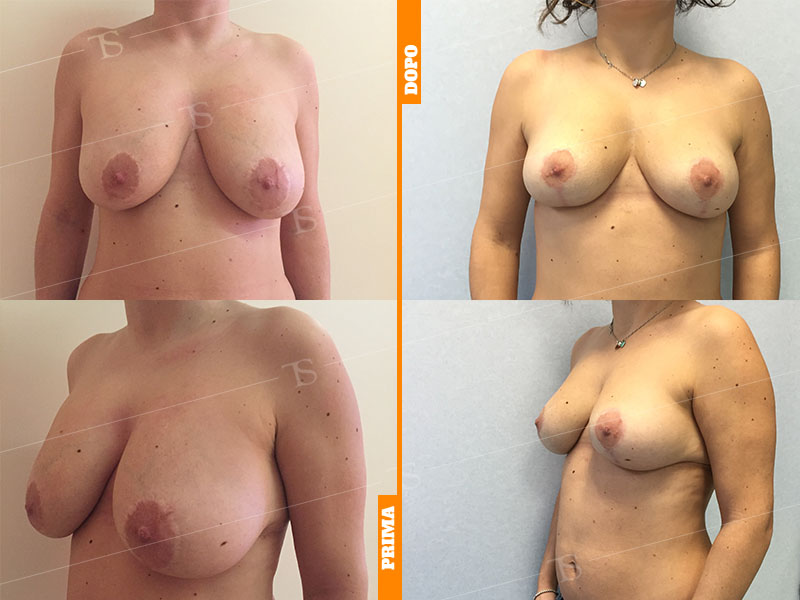
Breast implant removal and revision surgery
Breast implant removal and revision surgery
Definitive breast implant removal and revision surgery with mastopexy is indicated for people who can no longer bear to keep their implants, often at a young age or for various reasons. Often this choice is made by those who have suffered from relapsing capsular contracture or in those who have never accepted the implants and experienced them as a perpetual foreign body. A further situation is related to patients who have accumulated weight during pregnancy and want to lift their breasts and eliminate excess volume due to implants.
Aesthetic defects and solutions bringing to breast implant removal
The causes or reasons for requesting breast implant removal are :
previously inserted excessively large breast implants
recurrent capsular contracture; the capsule around the implant reforms hard and sore as before despite surgical removal
rupture of the implant
an increase in the overall volume of one’s breasts due to weight gain or menopause causing an increase in fat tissue
discomfort and a sense of encumbrance in relation to one’s daily or recreational motor activities
change in intimate desires related to one’s character or age.
When a patient requests definitive breast implant removal and refuses prosthesis replacement with a new implant (secondary mastoplasty), aesthetically satisfactory results cannot always be taken for granted. The patient must be aware that the surgeon will have to work with the scarce remaining breast tissue that is loose and stressed as a result of the previous surgery and time spent.
Specialist examination
Before coming to plan breast implant removal and revision reconstruction surgery the patient has often gone through several routes or even several surgeries to assess whether there are less radical choices. The removal of implants can be experienced as a defeat, but most of the time the patient who arrives at it does so as a liberation.From a diagnostic point of view, it is necessary to exclude the presence of pathological processes taking place in the context of the mammary glands. In addition to the common blood tests preparatory to any surgical operation, a mastoplasty involves an ultrasound, mammography or MRI scan and an electrocardiogram. During the examination, the patient presents the surgeon with doubts and expectations arising from the decision to undergo the operation. The doctor, on the other hand, examines the nature and anatomical characteristics of the breast (skin tissue, glands and adipose tissue), the general state of health of the subject (pregnancies and pathologies of various kinds) and, finally, explains the specifics of the operation, post-surgery and possible risks.
In addition to the electrocardiogram, ultrasound and mammogram, a check-up of blood tests will be required: blood count with leukocyte formula, blood glucose, creatinine, azotemia, plasma electrolytes (chlorine, calcium, potassium, sodium), total protein, liver function (ast, alt), cpk, cholinesterase, fibrinogen, ves, pcr, Ldh, ferritin, coagulation (pT, PTT), chest X-ray 1 week before, Covid-Sars2 swab to be taken 2 days before surgery
With regard to other indications that must be scrupulously observed:
the contraceptive pill must be discontinued at least one month before the date of the operation,
taking medication containing acetylsalicylic acid will be discontinued,
cigarette consumption will be reduced at least 4 weeks before surgery
it will be necessary to inform the surgeon about taking medication for ongoing therapies and treatments
The surgery
On the day of surgery, the surgeon will carry out appropriate pre-operative drawings such as during a mastopexy (key-hole) to symmetrize the proportions of the new breast and harmonise them with the parameters of the chest, which are the jugular arch, the midline, the axillary line, the midbrachial line, and the sub-mammary sulcus.
The implant will be removed and a capsulectomy will be performed if the implant has created severe tissue inflammation. The tissue will then be washed of any silicone residue if the implant has ruptured. The operation will continue with remodelling of the residual glandular with an upper pedicle mastopexy technique with a glandular self-prosthesis with an inverted T-shaped scar. To obtain the best result the patient, who is asleep, will be positioned with the backrest raised up to 70° as if semi-sitting. The operation is completed with the placement of suction drains and the closure of the planes.
In the case of a hybrid mastopexy and lipofilling technique, fat will then be grafted in a plane between the pectoral muscle and glandularis deep down or between the skin and glandularis on the surface using the “spaghetti” technique as described above.
Recovery times
Recovery time after a prosthesis removal operation is faster than after a prosthesis insertion operation. After the operation, drains are left for at least a day but in the case of a capsulectomy even a few days longer if the serum is abundant. A compression dressing is applied. The bandages are then replaced by an elastic bra (‘sports’ bra, without underwire, with an anterior opening and well restraining) that must be worn for at least a month (but it is recommended to continue to use it for subsequent periods to enhance the result). For the first 15 days, however, it is recommended to avoid exertion involving arm movements: the patient should be supported in carrying out tasks such as shopping, cleaning at home, looking after small children. Only then can normal activities be resumed, always following the surgeon’s instructions. It is important, in the seven days following surgery, to avoid contact of the external sutures with water: it could jeopardise proper healing. In the event of post-operative discomfort (numbness, pain and swelling), painkillers are prescribed and, to ward off infection, the surgeon may also indicate antibiotic therapy.
Costs
The costs for a breast augmentation operation can range from EUR 5500 to EUR 9000 in the case of a hybrid mastopexy with lipofilling with nanofat.
Breast implant removal -en bloc removal and corrective mastopexy